

Photo credit: Chelista E. Linkous
Dear Readers,
What a pleasure to read so many poems about nature entwined with the complexity of the human condition! The poems in Summer 2025 (6.1) show a depth of mindfulness about this planet we live on and the wonderment it holds for us, reflecting acute—and sometimes surprising—powers of observation against the backdrop of this rather unsettling world.
The submission window for Winter 2026 (6.2), which will have change as its theme, will open January 1, 2026.
Peace&Hope,
Kevin J. McDaniel, Founder and Editor
Nancy Dillingham, Associate Poetry Editor
Featured poets: Ace Boggess, Kay Castaneda, Meagan Chandler, May Garner, Robert Gibb, Zara Hart, Michael J. Kolb, Irene Mitchell, Jeff Newberry, Sherry Poff, Meggie Royer, Elli Samuels,
Jan Zlotnik Schmidt, Yvette Schnoeker-Shorb, Annette Sisson, Jeff Thomas, Jane O. Wayne
__________________________________________________________________________________
Nature Versus Nurture
Rain grays a hot day.
Doe & her fawns
hide in woods few yards away—
less wet than I am
in my Hawaiian shirt,
standing on the patio
saying a prayer with fire.
The fire dodges raindrops &
won’t give out.
Water knocks at the door beside me
with a gentle fist.
Wind cools, but not the fire
that pulses like a heart
in my hand.
Let’s Feast
I’ll trade mystery meat
for your beans & cornbread,
cereal for your boiled egg.
No innuendos, you great
gutter-minded galoot.
This is food, the real-deal meal,
How-to-get-by-in-prison-
when-you’re-a-picky-eater 101.
My breakfast for your lunch,
my milk for your juice.
Stop that drooling.
You raunchy rapscallion,
you razor-tongued roustabout,
servant of the misty mouth.
This is business, never
pleasure, not pleasurable
doing business with you:
my macaroni for your fake
fish, my turkey bacon
for your pancake syrup,
my bread alone for your Word
when words are all we have.
Ace Boggess is author of six books of poetry, most recently Escape Envy. His writing has appeared in Indiana Review, Michigan Quarterly Review, Notre Dame Review, Hanging Loose, and other journals. An ex-con, he lives in Charleston, West Virginia, where he writes, watches Criterion films, and tries to stay out of trouble. His forthcoming books include poetry collections My Pandemic / Gratitude List from Mōtus Audāx Press and Tell Us How to Live from Fernwood Press, and his first short-story collection, Always One Mistake, from Running Wild Press.
________________________________________________________________________________________________________
Sylvia’s Song
For the poet Sylvia Plath
Your critics laid you out hands tied,
wrapped you in white sheets, strips of tape,
pulled the cloth tighter like the Egyptians
prepared mummies for the next world.
The healers stuffed cotton in your mouth,
under your tongue so you’d stop talking.
Then they ripped the pen from your hand.
When you were all trussed up, roped
and strapped to that hard bed,
your bare back frozen, stuck
to the stainless steel, your legs stiff and wet,
glued down on that leather bedspread,
they gloated. The embalmers admired their work.
But the background light, hospital green,
wasn’t the right color for their creation.
They were full of envy, those devils,
about the way you had with words,
how you poured all your passion out
when you wrote on the page. Those pages
live preserved in dark temperature-controlled
vaults, hundreds of pages, hand-written,
copied, sent out with love to men
who didn’t know how to read.
You should have written love letters to mannequins
or paintings, cowboys on horseback, not dead
characters in novels. Epic heroes
would’ve remained for years at your side.
Even naked statues in museum halls
would have stared back at you, met your gaze,
given you a reason to stay here in your world.
But those experts feared a woman who could say
things, who arranged words for guests
as she placed cups on tables at an afternoon party.
Those ingrates! You invited men who couldn’t taste,
could not drink your sweet and bitter tea.
Your captors shot you full of poison,
assaulted you with their venomous words.
For a remedy, they drowned you, held you under
when you screamed, I’m talking.
But they turned up the heat, the force, tried
to redirect the current of your words. That wasn’t good
enough. You screamed so loud, they cut people from
your stories, changed your ending, edited you out.
We still hear everything you say. You’re unwrapped now.
They’ve removed all the bindings. But they won’t stop
remaking, reworking, revising every word you wrote.
I come with the others, not the ones who sent you
away. I stand in line with the pilgrims to view the dead.
I push my way to the front of the line to look
and to touch you, sign your guest book, turn the pages
of your epitaph.
I hear you speak, Sylvia. I hear you speak.
Kay Castaneda is a retired English teacher. She earned a B.A. and M.A. at IUPUI. She writes poetry, fiction, and non-fiction. Kay attended writing seminars in Lithuania, Scotland, and Mexico. She published a novel based on her experiences growing up in the Midwest, Emmie of Indianapolis. Her work in progress is a YA mystery novel. Kay lives in Mexico with her husband, son and dogs Whitey, Buddy, and Negra.
_______________________________________________________________________________________________________
Nestling
The robin’s eyes never close.
From her shaded porch column,
she freezes at each fast blur
behind the door’s window—
only leaving her eggs
to pluck from damp soil. Or waits
on the branch of an American beech
while we rock in wood chairs.
Sometimes as a child,
I woke to my mother’s hand
on my back. I was checking your breathing
she said when I shuddered,
her voice, the only way to know her
in the dark. After she left,
I was alone to wonder
how ready death was for me.
Deep night, my breath, and the fan’s.
Tucked in a cross-generational,
thinly swathing quilt, I heard
every disturbance inside and outside
my house. Cracks within walls,
storm-rustled leaves of a leaning tree,
the shatter of an egg fallen from its nest.
Meagan Chandler holds a B.A. from Baldwin Wallace University and an MFA from Bowling Green State University. Her works have been published in journals such as Inscape, Rockvale Review, The Ekphrastic Review, The Shore, and Allium, A Journal of Poetry & Prose.
_______________________________________________________________________________________________________
The Suicide Tree on Sonora
I was eight when I learned
that grief hums.
Not like a song,
but like a ceiling fan
in a room nobody visits.
I left the backdoor cracked
for years, just in case.
Just in case you wandered back
to the scent of your own ghost.
Mother washed the blood from her eyes
with rose-colored soap,
whispering we’ll be okay.
But her smile spilled sideways
and slept away for months.
Sometimes I think I saw you
in the backyard, where your tree stands hollow,
just like your memory.
Where the branch you hung your heave no longer grows
and the rope no longer swings.
Maybe I just wanted something to forgive.
Rosewater
My mother stands in the midnight kitchen,
her hands elbow-deep in a sink of scalding water,
scrubbing at plates already clean.
The soap smells of roses and rust —
a sweet deceit to cover for the iron of blood.
Each night I watch her wash the same glass twice,
as if she can rinse away the ghost that haunts our home.
By morning, her eyes are rimmed in raw pink,
but she still presses a smile onto her face,
braids my hair with trembling fingers.
There is a prayer in her silence,
a hymn in the clatter of porcelain and running faucets.
I tiptoe through our days, careful not to shatter
the fragile calm she had pieced together.
In the quiet, I collect the unspoken shards,
the sigh stifled in her throat,
the way she clenches her jaw when she passes his empty chair.
I want to tell her I remember him, too —
the thunder of his storms, the whiplash of his taking.
I want to tell her we are better off without,
but we have forgotten the language of comfort,
so I stand behind her in the dark,
listening to water, soap, and whispered names.
My mother keeps scrubbing until the sink overflows,
until all our grief runs clear down the drain.
May Garner is a poet and author based out of Dayton, Ohio. She has been dedicated to crafting and sharing her work online for over a decade. She is the author of two poetry collections, Withered Rising and Melancholic Muse. Her work has also appeared in Querencia Press, Cozy Ink Press, Arcana Poetry Press, and Ohio Bards. Find her work on Instagram (@crimson.hands).
_______________________________________________________________________________________________________
Turtles All the Way Down
The turtle’s lethal encrusted bulk—
This morning I woke with that stray phrase
Surfacing through my sleep,
The snapper having dredged itself up
From the muck of a pond,
Dragging the chain of vertebrae in its tail.
Ridged shell. Snorkel snout.
That worm of a lure on the tongue
Where the trap snaps shut.
My friend just happened to look up
As a duck was being yanked
From the surface of his pond
By what lurked in its depths,
The sudden clamor and thrashing wings
The storm before the calm.
Alligator snappers, cold-blooded
Since the Pliocene, with those jagged beaks
Snipped as if from tin.
The depths held such hungers
I learned one night, now I lay me down,
Surrounded by the darkness
In which another darkness stirred.
Pheasant
The bird lay motionless on the living room floor,
Having crashed through the sky
In the windowpane,
Scattering that ground zero with glass.
“It’s a hawk!” my friend was shouting,
Rattled by what had come into our lives
From out of the blue,
The way that some things do.
Was the hen dead or just knocked senseless?
Mayhem’s house call stunning us both,
It took a moment before I knelt
To brush bits of glass from the pheasant,
Checking for signs of breath.
A moment more before I carried
The mottled brown body back outside
Where it might wake and find safe passage
Beneath the actual sky.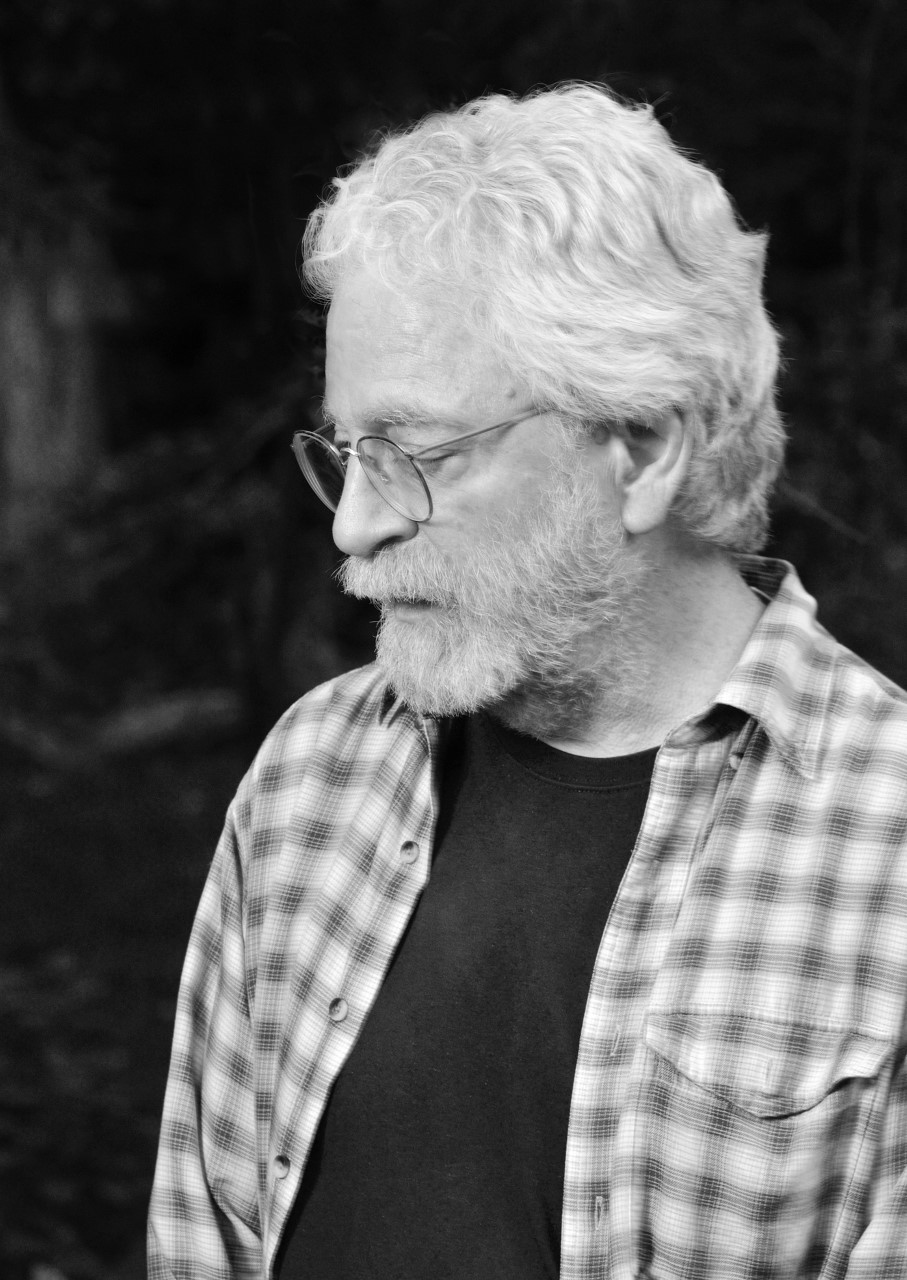
Robert Gibb is the author of 14 books including The Origins of Evening (National Poetry Series, 1997). Other books include Pittsburghese (Wheelbarrow Poetry Prize, 2023), Sightlines (Prize Americana in Poetry, 2019), Among Ruins (Ernest Sandeen Prize in Poetry, 2017), After (Marsh Hawk Press Poetry Prize, 2016), and The Burning World (Miller Williams Poetry Prize, 2004). He has also been awarded a Pushcart Prize, an appearance in Best American Poetry, and Prairie Schooner’s Glenna Luschei Award (2012) and Strousse Award (2011).
________________________________________________________________________________________________________
Baptism
There’s a sweetness on my lips
and there’s a rush
from the rattling of my bones beneath my skin
from the looping
of tires on gravel.
Her hair disappears like spun sugar underneath
the moon-laden morning sky.
We smile at one another, eyes flash in the mirrors
before she downs the whole bottle of Maker’s Mark
like it’s a game,
like sitting on the dock is an everyday pastime,
like the fish that flounder around
are old friends stopping to wave hello.
The weeds are tall grass in summer,
the tangled black arms
of some demon that clings
to our ankles
and our ribs.
She doesn’t care, she keeps on laughing
with her head thrown back
and her throat as pale and cold
as the sliver of the moon,
her teeth like stars. 
Zara Hart is a poet and fiction writer born and raised in western New York. She received an A.S. in Psychology and a B.S. in Creative Writing. Her work has appeared in Phantom Drift, Jigsaw, and Cabbages & Kings. When she’s not writing, she’s working at a local social services non-profit and spends as much time in the woods as often as possible.
_______________________________________________________________________________________________________
The Brief Season of Letting Go
Cold arrives as reminder, not reprimand.
Goldenrod slouched, hollow with effort.
This late October, a hush with edges.
This brief season of letting go.
Geese arrow south, urgent as reckoning.
The wind, unsummoned, takes what it can.
What once was bloom,
now husk, shadow, stain.
Petals settle into rigid poses,
into mulch,
into almost.
Even a brittle leaf has music.
Even the ending is not without grace.
Dear Body, Ghostly Engine
Dear body, ghostly engine, traitor saint,
you knew before I did.
The small betrayals:
words slipping sideways off my cheek,
balance falling behind,
a headache blooming in sudden light.
I said: I think I’m fine.
You answered with static,
that strange buzz I’ve come to fear.
You let me fall just far enough
to feel it,
offering comfort in fractured cadence.
Not healing. Not harm.
Just rhythm,
a knock at the base of my skull,
like a door
that never learned to close.
Now I trace the outline of myself,
naming flickers, tremors, ghosts.
Sparks I thought were gone.
You don’t explain.
And I learn to kneel
in the moonlit garden,
where silence
still wants me.

Michael J. Kolb is a poet and a professor of archaeology based in Colorado. He writes across disciplinary thresholds, exploring nature, memory, commemoration, and illness—asking what we carry and what we leave behind. His work appears or is forthcoming in Third Wednesday, Sky Island Journal, Eunoia Review, Defenestration, and Moss Piglet among others. He is the author of Making Sense of Monuments (Routledge 2020) and shares his writing on Instagram @michaeljkolb and at substack.com/@michaeljkolb.
_______________________________________________________________________________________________________
The Far Field Leads Farther Afield
Primed to win the battle
over overwhelming bouts of doom
I imagine that beyond the impenetrable plateau
is a field where dandelion heads
come to their end at the call
of a wind gust, proof that if any heads do remain
it is only through a contest of will.
That is my lesson. Hallelujah
that doom can vaporize into something else,
underscoring the fact that resistance
is a useless commodity ever flaunting
its price: all heads lost.
The spoils of battle include a row
of unvanquished dandelion
signifying bravery, heralding a return
to the far field for a watchful stroll
among the impenetrable fuchsias.
Now to find the precise term to wield
when describing watchfulness,
that Proustian seeking of steeple after steeple
in order to lay a path deep in the heart
while keeping a piece of sky close
to one’s position in equatorial space.
Achievement
Contrary to scientific persuasion,
I can engender a thought
that makes my heart flutter.
Such thoughts usually contain
raptures on love or beauty,
but, in the scheme of this person’s life,
that is not unusual.
Confidentially, my tracks along the path
of these raptures
have the glaze of melancholy
which makes it more appropriate
to want to keep them
in reserve for another time
when such moods lift,
when rue and regret shall no longer be worn
as adornments.
Be assured, that is how I want it to be,
simple and true to the exact day
upon which I happen to be walking
fit as a lion
early in the morn.
Irene Mitchell is the author of nine poetry collections, most recently An Overdose of Meditation (Dos Madres Press, 2024), My Report from the Uwharries (Dos Madres Press, 2022), and Irene Mitchell: Selected Poems (FutureCycle Press, 2021). Formerly Poetry Editor of Hudson River Art Magazine, Mitchell is known for her collaborations with visual artists and composers. She was a recent Associate Artist in Residence at the Atlantic Center for the Arts.
_______________________________________________________________________________________________________
On Hearing the Cane Fields Are Burning
A boy, I learned to chew and spit
the fibrous flesh that seemed to swell
in my mouth until the sweet left me jawing.
I swallowed it down despite warnings.
“You’ll get sick as a dog,” they said.
My father found stalks at roadside
stops for pickled eggs and evening six
packs, where leather-faced men poured
out the resin of their days. The body
refuses to digest cane, so I vomited out
back and kicked dirt over it, a dog.
Now the fields are aflame, the sky dark
as molasses, a burned and sweet stench.
Oily tendrils in the wind, smoke
curlicues into meaningless hieroglyphs.
In town, the old timers sniff it and never
complain. Cane burning time pulls the past
from their eyes, a sepia-shattered vision
they regurgitate and chew like a cud.
Nothing as steady as a clock’s rigid hands,
Nothing like the boxed days on calendars
or the charted edge of old photographs.
Whatever burns is not destroyed but changed.
The sooty fog in the air was once sweet.
Accept the memory like smoke. Inhale it.
Exhale it. Know that it changes you inside.
The fields have to burn every year, they say.
They say that’s the only way they can grow.
Jeff Newberry’s most recent book is How to Talk about the Dead (Redhawk Publications, 2024). The president of the Southeastern Writers Association, he lives in South Georgia and teaches at Abraham Baldwin Agricultural College.
_____________________________________________________________________________________________________
Summer Psalm
Of honeysuckle in the hedges
opal fire in the twilight sky
a machete moon slicing the night
we sing.
In tubs of marigolds in the yard
spider lace in morning grass,
tiny white-throat’s cheery whistle
we rejoice.
Teach us, we pray, to number our days,
find a glimpse of the long view
in bees on blossoms,
a model of faithfulness
in morning glories on the fence.
Kindred
All the other trees—maples, walnuts,
even the humble sumac—have long ago
dropped their leaves, surrendered
their wealth to the forest floor.
They have given themselves to the sky,
made room between their branches
for sunsets and lavender clouds,
moonlight and stars.
But the dry rustle of brown leaves, stiff
and misshapen in the winter wind,
sounds in my ears. The miserly
oak, old enough for better
wisdom, still holds to his bounty,
his tokens of plenty. And I know
his kind. I, too, have clung
to fading memories
of green shade and warm breezes,
sunrise and laughter. I, too, have faced
cold days with reluctance, unwilling
to lose what I cannot keep.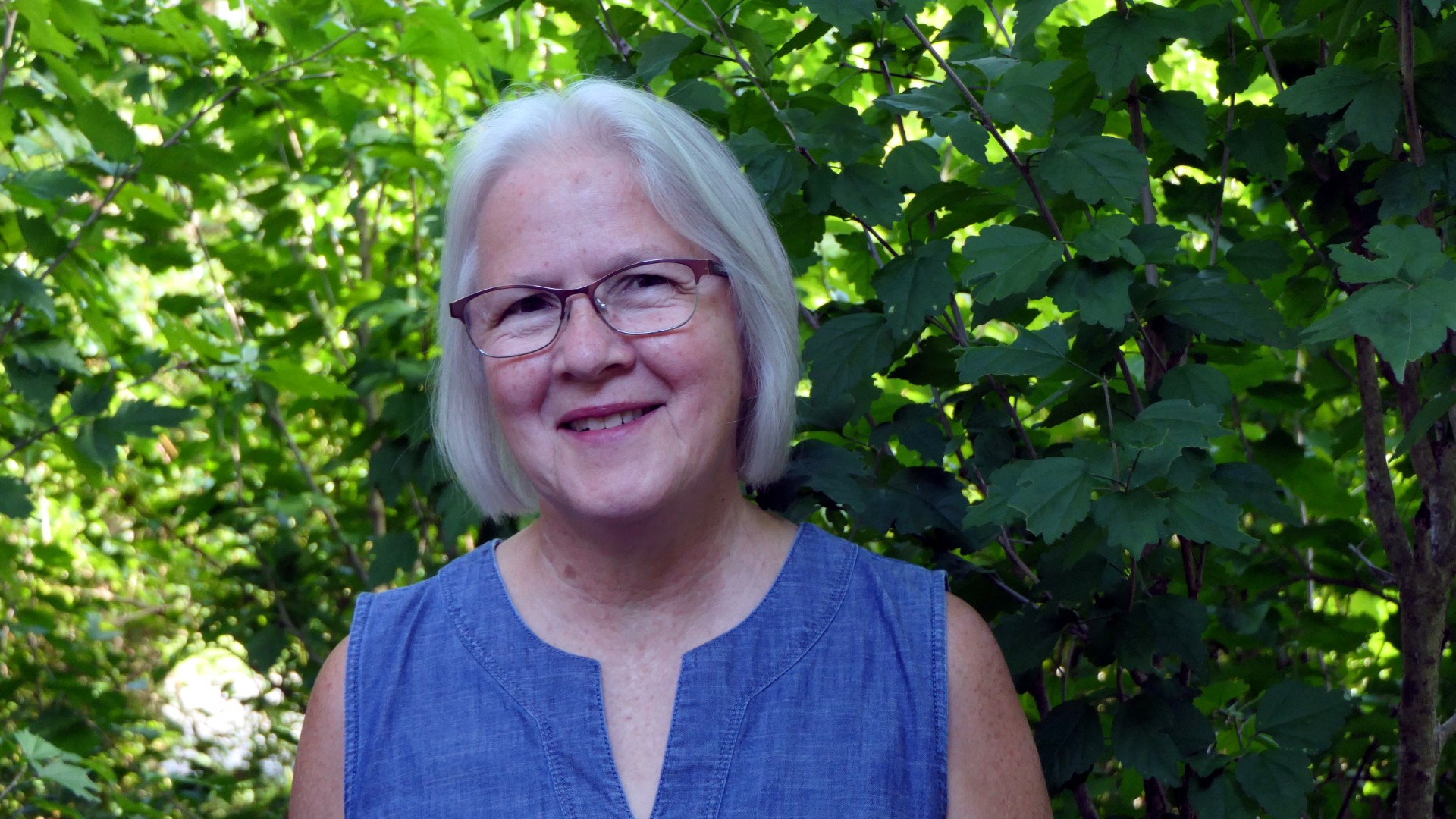
Sherry Poff enjoyed an idyllic childhood in the hills of West Virginia. She now lives and writes in and around Ooltewah, Tennessee. Sherry is a member of the Chattanooga Writers’ Guild. Her stories and poems have appeared in various online and print publications including Salvation South, Heart of Flesh, Pine Mountain Sand and Gravel, and The Clayjar Review.
______________________________________________________________________________________________________
Temple Grandin
My father showed us the film about the woman
who invented a more humane contraption
to move animals along to their deaths,
knowing this was paradoxical, knowing there were some
for whom this would make no difference,
knowing the farms we had come from
with bats hanging in the rafters like lanterns,
grass so wet it shone like floodlights,
women whose deaths I tracked for days,
the cow in the barn that would try
and try to give milk,
the milk that never came.
This was the film we saw because
there wasn’t any other to see.
Just the end coming a little slower.
Just the whales, the moon.
The house with its lights off for days.
The occupants whose lives we couldn’t determine
were still lives.
This Poem Could Have Been an Email
Like the one I’d sent the administrator who transitioned
to another school, after she’d left and before I realized
it wasn’t proper, begging her
to use the right term to identify the part of my life
that would end up being most of my life,
like the neighborhood corridors
I’d walk down in the dark
needing each interminable square of light
to be more than just the aftermath of dinner followed by television
or television followed by dinner
or the man who did the thing that resulted
in the begging,
or the poems that strangers etched into sidewalks out of fear
that one day there would be no sidewalks
or no poems, or just poems written by intelligence
so artificial it mostly mimicked humans who were mimicking
their ideas of being human
or the sky of stars that were really just blinking lights
from power distribution towers
like not everyone can make something
what you really need it to be
Meggie Royer (she/her) is a Midwestern writer and the Founder and Editor-in-Chief of Persephone’s Daughters, a journal for abuse survivors. She has won numerous awards and has been nominated several times for the Pushcart Prize. She thinks there is nothing better in this world than a finished poem. Her work can be found at https://meggieroyer.com.
______________________________________________________________________________________________________
Vertigo of Thinking
Imagine a room meant for the 12 Steps,
like a nest feathered for what is to come.
There are women only. A spicy Cheeto, a red-headed
Raggedy Anne, Nedra, a skeletal one. Take your pick.
Some weathered as an old sun-beaten door.
More, warriors. Like eagles pressed into the wind.
Trina is always all smiles, dealing stuff hard as a two-mile stare.
Each of them—mushrooms, edible, with poisonous twin doubles.
They are determined to keep G-d by their sides.
Okay with play in their shadows,
but will admit vertigo of thoughts being the norm.
How attacks will rise with static, dispatch with no song.
If one could call up the sun, suggest a standoff.
Would there still be a need to mourn for an ocean on fire?
Elli Samuels is a poet whose work has been anthologized and published in numerous literary journals such as Maudlin House, Pif Magazine, and Tulsa Review. She is thrilled by the chain of cause and effect—what makes you display a cartoon on your fridge, where the flavor of a new word takes you, why loud music in the morning sounds different. A cookbook author and yogi, Samuels lives in Arkansas.
________________________________________________________________________________________________
Maud Lewis and Joseph Cornell: An Imagined Visit
Joseph Cornell: “[I have had] a ‘long romance with the elated world.’” (A quote from his last diary, written two days before his death.)
These two self-taught artists, outsiders
In their worlds, collide in my dreams.
He doesn’t know her verdant Nova Scotia meadows
lupines, snow drops, white and pink apple blossoms.
All stream across her mind the outside in
In the interior of her white small chicken coop cabin.
The exterior walls are covered with blue, red, and yellow birds,
butterflies, bees, masses of multi-colored flowers, and dark green trees.
.
On her front door four swans, two black ones, two white
and crimson, cobalt, sun-yellow tulips bursting in bloom. A blaze of color.
Inside the walls, cupboards, floor, pots, glass jars,
cups, all a canvas painted in rainbow shades.
I see her at her threshold, welcoming visitors, holding a sign:
“Paintings for Sale.” Her joyous smile warms me in my dreams.
Then I imagine him coming to visit. That scrawny, timid man
struck by these scenes of country life. Almost speechless.
Snowy fields, winter sleigh rides, covered wooden bridges,
black and white spotted cows, red barns, a harbor struck by light.
He is undone by such exuberance, such a flood of color,
an electric current coursing down his spine.
The unadulterated visions too much to bear;
he retreats aware that she bring her outside world in.
He returns to his basement studio among his trinkets, old books, star maps,
dolls, cutouts of birds, tulle from a prima ballerina, all swirling about him in dimming light.
Time spools back to childhood. He welcomes ghosts. Spinning tops,
old white pipes, magic shows, and empty shells in his boxed-in world.
I imagine: they talked for a moment before he was gone.
About the flight of birds in a star-filled firmament.
Breath transformed as light. Light as breath.
Elated moments captured in the stillness of memory.
Jan Zlotnik Schmidt’s work has been published in many journals including The Alaska Quarterly Review, Kansas Quarterly, Memoir, The Vassar Review, and The Westchester Review. Her work also has been nominated for the Pushcart Press Prize Series. She has had two volumes of poetry published by the Edwin Mellen Press (We Speak in Tongues, 1991; She had this memory, 2000). Her full-length volume, Foraging for Light, was published in September 2019 by Finishing Line Press. Recently her chapbook about Bess Houdini, Over the Moon Gone: The Vanishing Act of Bess Houdini, was published by Palooka Press.
_______________________________________________________________________________________________________
Lost Souls Love It Here
A slight shift in wind, in season,
and the rusty gold and black
of a flitting swallowtail
changes into a drifting elm leaf
that floats between flickering,
lightning fast approaching;
ghosts dance wildly in darkness,
their electricity filling slate-gray skies,
as our eyes stalk tips of conifers—
do you feel the storm
warnings, ominous ions swirling
shadows? This is a lovely place
to die. Lost souls love it here. The deer
don’t care; elk don’t care; bears don’t care;
small creatures crawling over or under
mossy logs don’t care. There is now
only the silence of glossy grasshoppers
who long ago courted, bright wings
clicking gently, translucent angels
in aromatic air before the sun
began to pass behind the clouds.
Rhizomes
Secretive little runners,
they produce life below
fertile soil, ignore the surface
nonsense of our species,
generate roots and shoots,
oblivious to human creepiness.
Quiet and covert, they occupy
subterranean space, lace
the underground with nodes
of hope, gentle connections,
perfection as Nature intended,
as we surrender to our instincts.
Rhizomes need no culture,
no social hierarchies
to flourish, only potential
for budding beauty,
nourishing the mother plant
or us—they know more
about continuing existence
than Homo sapiens ever will.
Yvette A. Schnoeker-Shorb is the author of the chapbook Shapes That Stay (Kelsay Books, 2021). Her poetry has appeared in the New York Quarterly, Slipstream Magazine, The Sucarnochee Review, The Midwest Quarterly, About Place Journal, Chestnut Review, Plainsongs, Speckled Trout Review [Issue 2, Spring 2020], and elsewhere. She holds an interdisciplinary MA and has a special fondness for tarantulas, peccaries, and anything in the Corvidae family.
_____________________________________________________________________________________________________
Seizing the Throne
A five-week tragedy unfolds outside the kitchen
window. Day after day the pair of red-bellied
woodpeckers hammers, grooms the hollow,
a clutch of smooth eggs stowed. This morning
a European starling hovers, blocks the cranny.
Returning, the male woodpecker blares his despair,
sidles up the trunk—a drama of nest overthrown,
usurped, like Richard the Third slaying the young
princes in the tower, ensuring his progeny’s rule.
Non-native as a Tudor in the house of Plantagenet,
this starling enacts its pact with evolution, beggars
the parents’ spring labors, April’s mantle of gold
no consolation for scattered shards of beak and bone.
Annette Sisson’s poems appear in The Penn Review, Birmingham Poetry Review, Rust & Moth, and many other journals and anthologies. Her second book, Winter Sharp with Apples, was published by Terrapin Books in October 2024. Her first book, Small Fish in High Branches, was published in May 2022 by Glass Lyre Press.
______________________________________________________________________________________________________
Leaving The Thumb
My father’s eyes swam in the stagnant
puddle inside our tire swing. The rope
snapped, I bounced my head off roots
and woke up to the dog licking my face,
to the sound of little cousins, voices echoing
like bells off our brick house. My teeth scraped
blood off my tongue. I followed the narrow
footpath to the Belle River. A cardinal, two
sparrows, and a robin sang from the hedgerow.
Pheasant wings drummed sky like thunder
when I flushed a ring-necked rooster from
high grass. I sat on the flat rock and dipped
my toes in the water, opened my mouth and cooled
the throbbing inside with brisk autumn air.
Rotten tree limbs floated straight up where
the creek intersects the river. The current spun dead
leaves ashore. I felt a river of blue inside me,
one hundred miles long, holding my heart in place.
Listening to the whistle of another empty train
rolling through town, I’d had enough rust
to choke on. I left first thing the next morning,
didn’t return any calls. I ate cedar off
the Huron coast, set the tide on my neck,
and drifted up to Mackinaw.
Jeff Thomas is a poet from The Thumb. His poems center his experiences working blue-collar jobs and growing up in rural southeast Michigan. Entering his second year studying in Eastern Washington University’s MFA program, Thomas is an instructor of creative writing and college composition as well as the poetry editor for Willow Springs Magazine.
______________________________________________________________________________________________________
On the Basement Stairs
Midway up the basement stairs
when the laundry grew heavier in her arms,
and she stopped
to catch her breathe, she could hear
a piano playing softly in the distance.
Or was it in memory— that night
when she once walked in rain
while a Chopin Nocturne flooded the plaza?
Sorrow without words.
She might falter on the steps, but she still
holds keys to doors that closed behind her
years ago, the same doors
that open at the strangest times. Earlier
in the empty house when the dog barked,
he broke the silence of another dog.
Somewhere a black sock
fell out of the load of laundry in her arms.
What else slipped from her along the way?
These are her adagio years—
the metronome set to slow,
solitude humming to itself.
Jane O. Wayne has four poetry collections: Looking Both Ways (University of MO Press), which received the Devins Award for Poetry; A Strange Heart, which received the Marianne Moore Prize and the Society of Midland Authors Award; From the Night Album (Pecan Grove); and The Other Place You Live (Mayapple Press). Her work has appeared in Poetry, The Iowa Review, Ploughshares, The American Scholar, The Journal, The Cincinnati Review, The Massachusetts Review, Poetry Northwest, The Michigan Quarterly Review and others.
 Speckled Trout Review